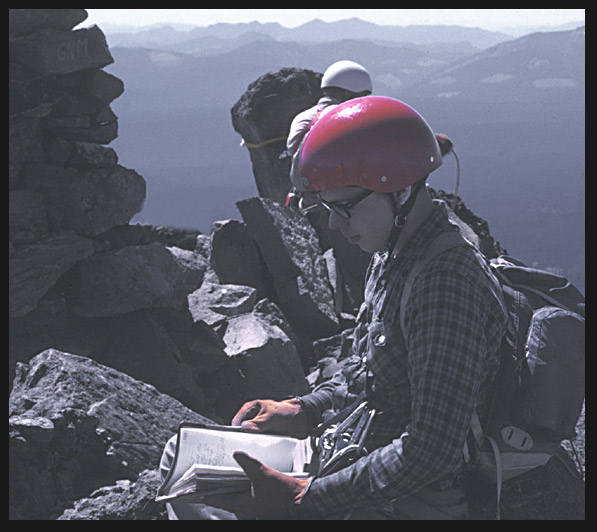
It was a scarey climb up, "just" the standard route on Mt. Washington, a I-3 according to Nicholas Dodge in my 1968 version of "A Climbers Guide to Oregon.... The 7,794 foot summit was warm, the writings in the summit register a fine distraction from the intrusive thoughts you could not shake: "What about the rappel?" It's an inescapable fact, there's a lot of air under your feet as you back over the edge and let yourself go. It's afternoon by the time you reach the rappel point, and the east face below you is in deep shadow. Somehow that doesn't help, it just makes the whole scene seem colder and more ominous. The safety of your car at Big Lake nearly 3,000 feet below seems terribly remote.
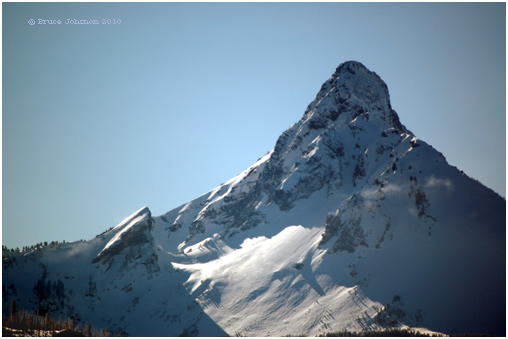
Below is an image of the northeast face of Mt. Washington in the wintertime (late January 2010). This surely proves the status of this little peak as a worthy objective for serious and experienced climbers! Access is easier now that the giant B&B Fire of 2003 thinned out the surrounding forests so well.
 Geocaching: This relatively
new sport is a high-tech activity that seems to draw its inspiration
from the grand old tradition of mountaintop summit registers.
You fight, you struggle, you endure bad weather and bugs for the
prize--- a link to other similar travellers of the out-of-doors,
both past and future. You read of their journey, you enjoy the
surprises of their little leavings, and you carefully compose
a few lines for future readers to hear of your journey. At the
time, it probably never occurs to you that this one day in Time
may be the only time in your Life that you stand here with this
opportunity to say something for others about this adventure you
have had this day... I recall the words from a 1973 popular song
by Seals and Crofts: "We May Never Pass This Way Again,"
was its title, and its theme had something to do with valuing
the moment in Time.
Geocaching: This relatively
new sport is a high-tech activity that seems to draw its inspiration
from the grand old tradition of mountaintop summit registers.
You fight, you struggle, you endure bad weather and bugs for the
prize--- a link to other similar travellers of the out-of-doors,
both past and future. You read of their journey, you enjoy the
surprises of their little leavings, and you carefully compose
a few lines for future readers to hear of your journey. At the
time, it probably never occurs to you that this one day in Time
may be the only time in your Life that you stand here with this
opportunity to say something for others about this adventure you
have had this day... I recall the words from a 1973 popular song
by Seals and Crofts: "We May Never Pass This Way Again,"
was its title, and its theme had something to do with valuing
the moment in Time.
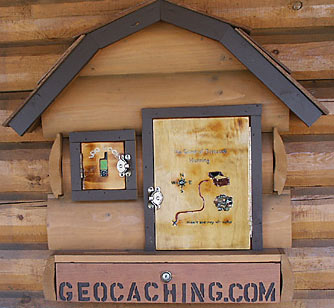
The geocache site shown to the left is located on the side of a store just outside the entrance to Fort Stevens State Park, on the north Oregon Coast.
